
Key Takeaways
- Termites eat wood, while carpenter ants tunnel through wood to build nests, which leads to different types of structural damage.
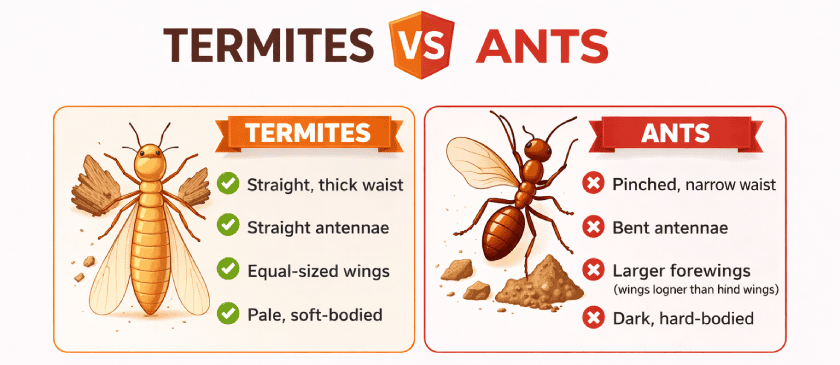
- Physical traits help identify them quickly. Termites have straight antennae, thick waists, and equal-sized wings, while ants have elbowed antennae, narrow waists, and uneven wings.
- Termites usually cause more severe damage because they continuously feed on wood and form larger colonies.
- Signs of infestation differ. Termites leave mud tubes, hollow wood, and pellet-like droppings, while carpenter ants leave wood shavings and visible trails.
- Professional inspection is important because misidentifying the pest can lead to ineffective treatments and costly damage.
Termites and ants may look similar, especially during swarming, but they damage homes in very different ways. Termites eat wood and can cause severe structural damage, while carpenter ants tunnel through wood to build nests. Identifying the difference between termites and ants helps you choose the right treatment and prevent costly damage.
This guide explains the key physical differences, infestation signs, and how to identify each pest correctly.
Termites vs Ants: How They Damage Your Home
Both pests attack wood, but they do it in very different ways. Termites feed directly on wood and other cellulose materials. They chew through wooden beams, floors, and support structures from the inside out. Because the damage happens internally, it often goes unnoticed for months or even years.
Carpenter ants behave differently. They do not eat wood. Instead, they excavate tunnels to build nesting galleries. Over time, these tunnels weaken the structure of the wood. When comparing termite damage vs ant damage, termites usually cause faster and more expensive destruction. Their colonies are larger, and their feeding never stops. That is why early detection is so important.
Key Differences Between Termites and Ants
Many homeowners struggle with how to tell ants from termites. The easiest way is to look at their physical features. The table below highlights the difference between termites and ants in a simple way.
| Feature | Termites | Ants |
| Body Structure | The body appears straight with no visible waist | The body has a narrow, pinched waist between segments |
| Antennae Shape | Antennae are mostly straight or gently curved | Antennae bend in the middle, forming an elbow shape |
| Wings (Swarmers) | Two pairs of wings that are the same size and length | Front wings are noticeably longer than the hind wings |
| Wing Behavior After Swarming | Wings are usually shed shortly after the swarm | Wings drop off after mating takes place |
| Color Appearance | Typically pale, creamy, or light brown | Commonly black, brown, reddish, or yellowish |
| Body Size and Texture | Smaller insects with softer bodies | Usually larger with more defined body segments |
| Head Form | Rounded head shape | The head often appears triangular or heart-shaped |
| Outer Body Covering | Soft outer body | Hard outer exoskeleton |
| Development Process | Undergo incomplete metamorphosis | Develop through complete metamorphosis |
| Growth Stages | Egg → Nymph → Adult | Egg → Larva → Pupa → Adult |
| Colony Organization | Colonies include workers, soldiers, and reproductive. | Colonies include workers, queens, and males. |
| Swarming Behavior | Swarm seasonally, often mistaken for flying ants | Swarm during mating periods to form new colonies |

Physical Traits That Help You Identify Termites and Ants
Even small details can help with ants vs termites identification. Check out a detailed description of the most noticeable differences you should watch for.
Body Shape
One of the simplest clues is the body shape. Termites have a straight body that looks almost uniform from head to tail. There is no clear narrowing in the middle.
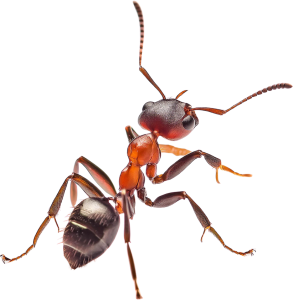
Ants look different. Their bodies have a noticeable pinched waist that creates a segmented appearance. This is one of the fastest ways to distinguish termite body shape from ants.
Antennae
Another helpful feature is the antennae. Termites have antennae that appear straight or slightly curved.
Ant antennae bend sharply in the middle, creating the familiar elbow shape. When comparing termite antennae vs ant antennae, this difference becomes easy to spot up close.
Wings
Wing structure is one of the biggest clues during swarming season. Flying termites have two pairs of wings that are equal in size and length. Their wings also extend well past the body.
Ant swarmers, including carpenter ants with wings, look different. Their front wings are noticeably longer than the back pair. This difference helps when checking termite wings vs ant wings.
Color
Color can also help with identification. Termites usually appear pale or creamy. Some even look almost translucent.
Ants show much darker shades. Most carpenter ants are black, dark brown, or reddish. This makes it easier to distinguish once you know what to look for.
Life Cycle Differences
Termites and ants also develop differently. Termite colonies follow a caste system. Workers gather food, soldiers protect the colony, and reproductives create new colonies.
Ant colonies have queens, workers, and males. Carpenter ant colonies grow slowly but can still become large over time.
Behavioral Differences Between Termites and Ants
Beyond appearance, the termite’s behavior also largely differs from the ant’s. These are some of the important clues.
Habitat
Understanding where termites live helps identify an infestation. Subterranean termites usually nest in soil and travel through mud tubes to reach wood. They prefer damp areas and stay hidden inside wood or underground tunnels.
Carpenter ants prefer nesting in wood as well, but they look for moist or decaying wood first. You may find their nests in walls, insulation, hollow doors, or wooden beams. These carpenter ant nesting habits often bring them close to kitchens or bathrooms where moisture is present.
Diet
Diet is another major difference. Termites feed on cellulose found in wood and plant materials. That is why they continuously eat through wooden structures.
Carpenter ants behave differently. They do not actually eat wood. Instead, they chew through it to create nesting tunnels and then push the debris out.
Tunnels and Nesting Patterns
The appearance of tunnels is another clue. Termites build mud tubes made from soil, saliva, and wood particles. These tubes protect them from light and keep moisture inside. This is why homeowners often notice mud tubes vs ant tunnels along foundations or walls.
Carpenter ants carve smooth, clean tunnels called galleries. These tunnels look polished inside and often contain piles of wood debris nearby. Examining the wood can help determine wood damage caused by termites vs ants.

Signs of Termites vs Ants in Your Home
Recognizing the early warning signs can prevent serious structural damage.
Signs of Termites
- Mud tubes on walls or foundations
- Hollow-sounding or damaged wood
- Discarded wings near windows or doors
- Buckling floors or sagging wood
These signs of termites in the house often appear slowly, which makes professional inspections important.
Signs of Carpenter Ants
- Large ants indoors, especially at night
- Wood shavings (frass) near walls or baseboards
- Rustling sounds inside the walls
- Visible ant trails
Unsure whether you are dealing with termites or ants? A professional termite inspection service provider can identify the pest quickly and stop hidden damage before it spreads.
Carpenter Ant vs Termite Droppings
One of the easiest ways to identify the pest is by examining the material left behind. Carpenter ants and termites leave very different droppings.
Carpenter Ant Droppings (Frass)
- Contains wood shavings, soil, gravel, and insect parts
- Irregular shapes and sizes with no consistent pattern
- Looks coarse or fibrous rather than pellet-like
- Often found near nests around windows, doors, or baseboards
- Usually pushed out of tunnels and piled below entry points
Termite Droppings (Frass)
- Termite Droppings are small, hard pellets or rounded capsules
- About 1 millimeter in size and very uniform
- Color changes depending on the wood the termites ate
- Often found beneath damaged wood or along baseboards
- Common near drywood termite nests
Treatment Options for Termites and Carpenter Ants
Getting rid of these pests requires different strategies.
Termite Treatment Options
- Baiting systems
- Liquid soil treatments
- Professional termite inspections
- Moisture control and wood repair
These termite control methods target colonies underground and prevent them from returning.
Carpenter Ant Treatment Options
- Targeted insecticide applications
- Nest identification and removal
- Moisture and wood decay management
- Sealing entry points
Effective carpenter ant treatment focuses on eliminating the nest and removing the moisture conditions that attract them.
When it’s Time to Call a Pest Control Professional
Many homeowners try DIY treatments first. Unfortunately, these methods often fail because the pest is misidentified. For example, treating carpenter ants when the problem is actually termites doesn’t solve the issue.
A professional inspection helps identify the pest correctly and locate hidden colonies. Experts also provide long-term solutions that protect your home. Professional pest control for termites and ants can stop the infestation early and prevent costly structural damage.
Protect your home from costly pest damage. Schedule a professional inspection with us and stop termites or ants before the problem gets worse.